
What Can Long-Term Molecular Persistence Tell Us About Human Biology?
By Neo7Bioscience

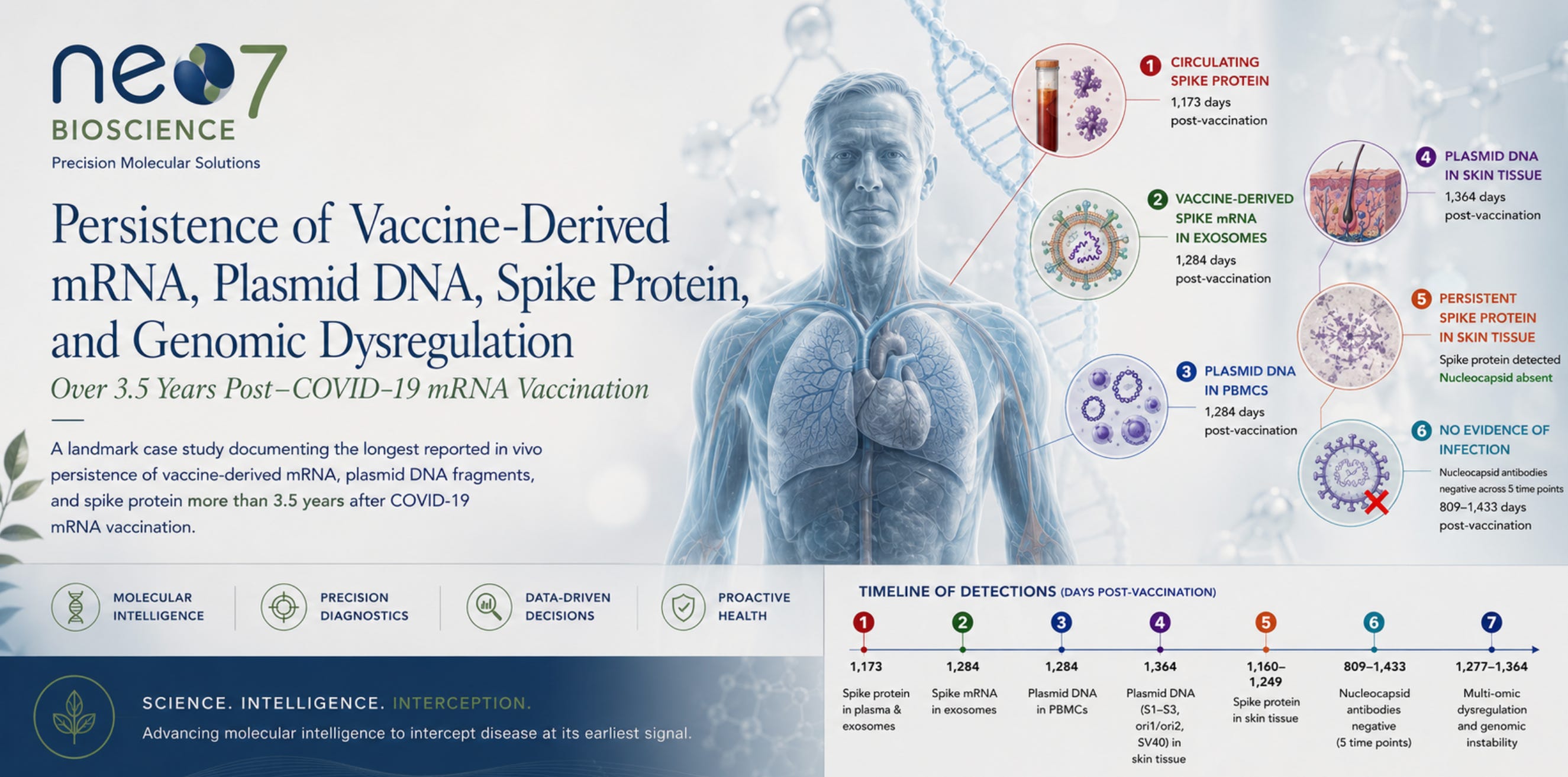
A recently published peer-reviewed case study by Nicolas Hulscher, Vanessa Schmidt, Michael Mörz, Claire Rogers, Natalia von Ranke, Wei Zhang, John A. Catanzaro, and Peter A. McCullough contributes new data to the ongoing discussion surrounding the long-term biological effects of COVID-19 mRNA vaccination. While representing a single extensively evaluated patient, the report documents molecular findings more than 3.5 years after vaccination that warrant continued scientific investigation.
Looking Beyond Symptoms
One of the most important shifts occurring in modern medicine is the recognition that biology changes long before symptoms appear.
Cells communicate continuously through proteins, RNA, DNA, metabolites, and signaling networks. When those systems become disrupted, clinical symptoms often represent the final stage of a process that has been developing silently over months or years.
Understanding these early biological signals is where precision medicine has the greatest opportunity to transform healthcare.
Findings Reported in the Study
The authors reported several notable observations in a patient evaluated over approximately 3.5 years following COVID-19 mRNA vaccination, including:
Detectable circulating spike protein 1,173 days after vaccination.
Vaccine-derived spike mRNA identified within circulating exosomes 1,284 days after vaccination.
Detection of plasmid DNA elements in peripheral blood mononuclear cells and skin tissue.
Persistent spike protein deposition observed in serial skin biopsies.
Persistently negative SARS-CoV-2 nucleocapsid antibodies throughout follow-up, which the authors interpret as evidence against natural infection during the observation period.
Multi-omic analyses reporting transcriptomic abnormalities, proteomic alterations, immune dysregulation, and evidence of genomic instability.
Together, these observations raise important biological questions regarding molecular persistence, cellular signaling, and long-term physiological adaptation.


Why Multi-Omics Matters
Traditional medicine often focuses on isolated laboratory values or single biomarkers.
Multi-omic analysis takes a different approach.
By integrating genomic, transcriptomic, proteomic, and other molecular datasets, researchers can observe how biological systems interact rather than evaluating each pathway independently.
This systems-level perspective provides a more comprehensive understanding of how biological changes may evolve over time.
The Importance of Continued Investigation
This publication represents a single case report and should be interpreted within that context. Additional research involving larger patient populations and independent replication will be essential to determine the prevalence, reproducibility, and clinical significance of these findings.
Scientific progress depends upon rigorous validation.
Every meaningful discovery begins with observation.
Every observation deserves careful investigation.
Why This Matters to Neo7Bioscience
At Neo7 Bioscience, our mission extends beyond diagnosing disease after it appears.
We believe the future of medicine lies in understanding biology before dysfunction becomes clinically apparent.
Our research focuses on molecular intelligence, biological communication networks, precision diagnostics, and systems biology to better identify early biological changes that may influence long-term health outcomes.
Whether investigating cancer biology, chronic illness, resilience medicine, or complex molecular signaling, our guiding principle remains the same:
Follow the biology.
Not assumptions.
Not headlines.
Not ideology.
Biology.
The Future of Precision Medicine
Medicine is moving toward a future where earlier detection, molecular surveillance, and systems-level biological understanding become central to patient care.
Every carefully conducted study adds another piece to that puzzle.
Continued scientific inquiry, transparent discussion, and independent validation are essential if we hope to better understand human biology and improve future healthcare.
At Neo7 Bioscience, we remain committed to advancing precision medicine through evidence-driven molecular research and to asking the questions that move science forward.
Science. Intelligence. Interception.
View Peer-Reviewed Study here:

Learn more: Mccullough Foundation
A Collaborative Contribution to Ongoing Scientific Research
The publication discussed in this article reflects the work of a multidisciplinary research team whose expertise spans molecular biology, pathology, genomics, clinical medicine, and precision health.
The study was authored by:
Nicolas Hulscher, MPH
Vanessa Schmidt, PhD
Michael Mörz, MD
Claire Rogers, PA-C
Natalia von Ranke, PhD
Wei Zhang, PhD
John A. Catanzaro, ND, PhD
Peter A. McCullough, MD, MPH
We recognize and appreciate the efforts of the entire research team in contributing new data to an important area of ongoing scientific investigation. Scientific progress is built through collaboration, independent inquiry, and the willingness of researchers to carefully examine complex biological questions.
Regardless of where future evidence leads, studies like this help expand scientific dialogue and provide valuable observations that can inform future research.
Contact: Neo7Bioscience
Stay connected for:
• Research breakdowns
• Educational reels & visual explainers
• Emerging molecular insights
• Precision restoration strategies
• Thought leadership from Dr. Catanzaro and collaborators
• Updates shaping the next era of healthcare
The future of medicine is becoming dynamic, individualized, and biologically intelligent.
Follow along as the shift unfolds.
Facebook: Neo7Bioscience
Instagram: @neo7bioscience
LinkedIn: Neo7 Bioscience
I, too, have a patient with confirmed spike proteins in her serum. Her last vaccination was at the end of 2021, and the lab results are from 2026.
From an Ob/ Gyn perspective , I’m still seeing death and destruction that increased during the rollout of the Covid jabs. This is not going away .