

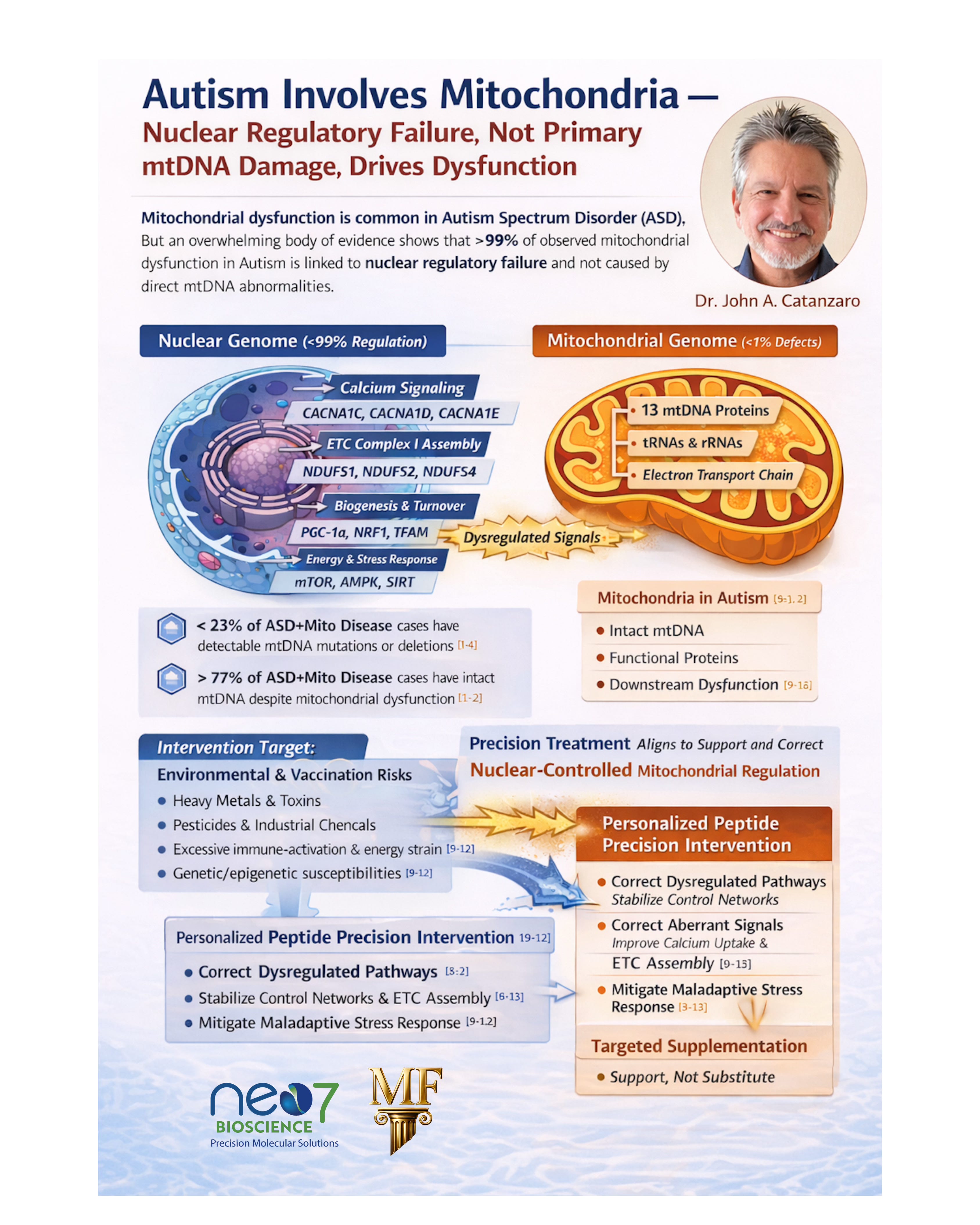
Mitochondrial dysfunction is one of the most consistently observed biological abnormalities in Autism Spectrum Disorder (ASD). That observation is correct.
The interpretation, however, has been persistently flawed.
Let this be stated clearly at the outset:
Mitochondria are involved in autism. Autism is not, in the overwhelming majority of cases, a mitochondrial DNA (mtDNA) inheritance disease.
The failure occurs upstream—within nuclear regulatory systems that govern mitochondrial behavior, immune signaling, and metabolic control.
mtDNA Abnormalities Are the Exception, Not the Rule
In rigorously characterized cohorts of children with autism and mitochondrial dysfunction, fewer than sixteen percent demonstrate detectable mitochondrial DNA mutations, deletions, or depletion. More than eighty-four percent show intact mitochondrial DNA despite clear mitochondrial dysfunction.
Independent studies confirm these findings and lead to a firm conclusion:
Mitochondrial dysfunction in autism is real—but it is overwhelmingly not caused by inherited or primary mitochondrial DNA failure.
Control Does Not Reside in the Mitochondrial Genome
The mitochondrial genome contains just thirty-seven genes.
The nuclear genome encodes more than eleven hundred mitochondrial-associated proteins.
Quantitatively:
Less than one percent of mitochondrial control is mtDNA-derived
More than ninety-nine percent is nuclear-controlled
Autism consistently demonstrates nuclear transcriptional dysregulation, protein–protein interaction instability, and immune–metabolic miscoordination, while mitochondrial structure is often preserved.
This is not mitochondrial collapse. It is a regulatory failure.
Mitochondria in Autism Are Functional but Mismanaged
Observed findings in autism include:
Inefficient ATP production
Redox imbalance
Abnormal stress signaling
Poor coupling between neuronal demand and energy supply
What is notably absent in most cases:
Progressive mitochondrial encephalopathy
High-burden heteroplasmy
Uniform electron transport chain collapse
Classic maternal inheritance patterns
The mitochondria are responding to corrupted nuclear instructions.
Nuclear Regulatory Vulnerability and Environmental Stressors
Nuclear regulatory systems are epigenetically vulnerable.
Environmental toxicants and non-precision immune stressors can disrupt transcriptional governance, destabilize calcium and immune signaling, and lock cells into chronic stress-response states.
This does not require mitochondrial DNA damage.
It requires nuclear regulatory vulnerability.
From a systems biology perspective, indiscriminately applying immune activation to genetically, metabolically, and developmentally heterogeneous children poses a serious biological risk.
Why This Matters Clinically
Autism cannot be addressed with:
Generic mitochondrial supplements
One-size-fits-all immune interventions
Denial of biological variability
You cannot correct a control-system failure by ignoring the control layer.
Precision Biology Comes First
At Neo7Bioscience, precision systems biology focuses on stabilizing disrupted nuclear regulatory networks, supporting mitochondrial governance, and restoring immune–metabolic coordination.
Through personal molecular surveillance and personalized engineering, deficient biological signals are targeted directly—matched to each individual’s unique biological expression—to correct signal flaws, deficiencies, and regulatory impairments at their source.
This work aligns with the McCullough Foundation’s commitment to scientific integrity, biological truth, and patient-centered investigation.
Final Synthesis
Let this be stated without ambiguity:
Mitochondria are involved in autism
Primary mitochondrial DNA disease is uncommon
The overwhelming majority of dysfunction reflects nuclear regulatory failure
The mitochondria are not broken.
They are mismanaged.
Autism is a disorder of biological governance, not genetic inevitability.
Precision biology must come first.
Dr. John A. Catanzaro
Neo7 Molecular Surveillance • Systems Biology • Precision and Personalized Engineering
Further Reading and Reference:
Poling JS, Frye RE, Shoffner J, Zimmerman AW. Developmental regression and mitochondrial dysfunction in a child with autism. J Child Neurol. 2006 Feb;21(2):170-2. doi: 10.1177/08830738060210021401. PMID: 16566887; PMCID: PMC2536523. https://pubmed.ncbi.nlm.nih.gov/16566887/
McCullough Foundation Report: Determinants of Autism Spectrum Disorder Changed Vaccine History Forever

https://ijvtpr.com/index.php/IJVTPR/article/view/125
For Further Information:

